
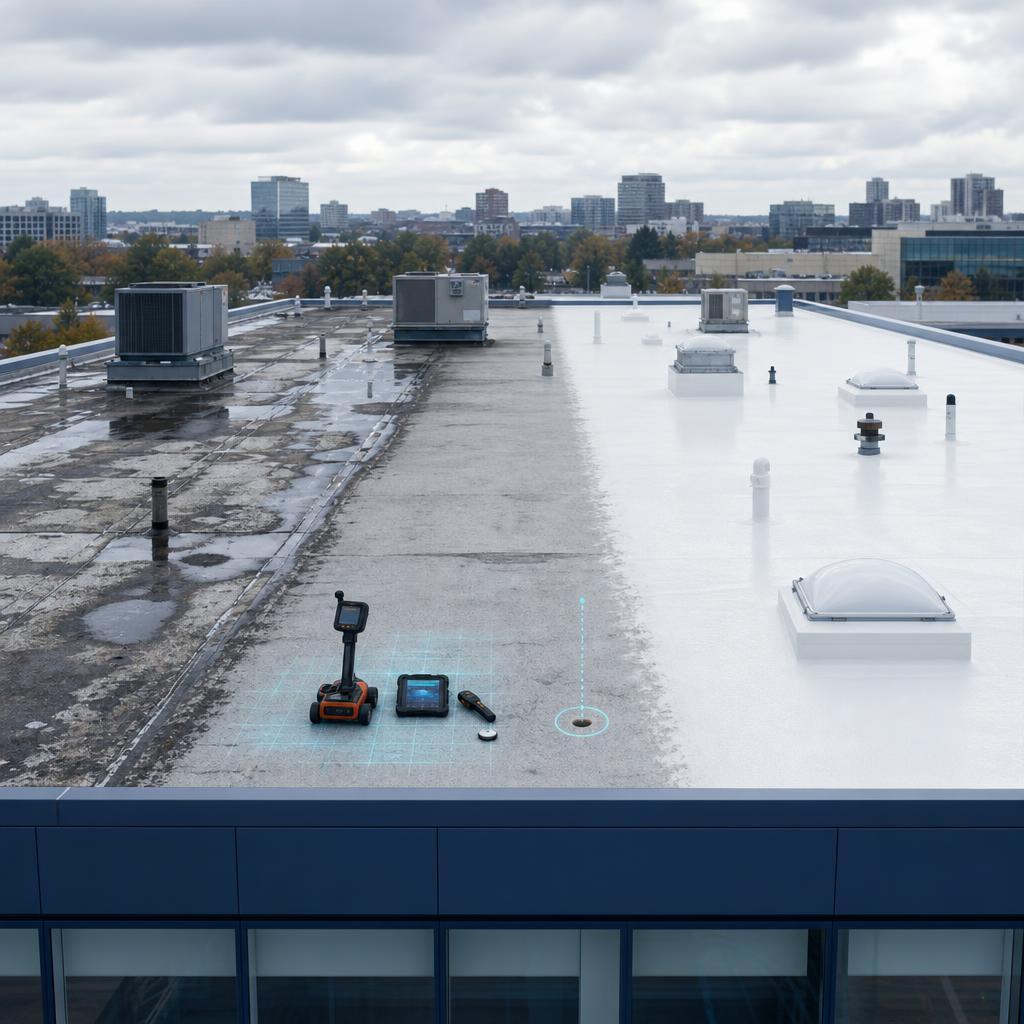
Start with the roof’s condition, not a preferred product
Commercial roof decisions are often framed too early as a product choice: coating or replacement, spray foam or membrane, repair or tear-off. The useful first question is different: what condition is the existing roof in, and which options remain technically appropriate?
A roof that looks worn may still have a sound deck and mostly dry materials. A roof that looks serviceable may conceal wet insulation, failed transitions, or deterioration below the surface. An assessment therefore needs to connect visible conditions with roof history, moisture evidence, drainage, details, substrate compatibility, code requirements, and the owner’s operational goals.
Key takeaways for building owners
- Restoration is condition-dependent. A coating is not a universal answer to leaks, wet insulation, or deck problems.
- Moisture extent matters. Localized wet areas may support a different scope than widespread moisture.
- Drainage cannot be ignored. Ponding, blocked drainage, low areas, and overflow paths can change both preparation and system selection.
- Recovery and restoration are not the same. Restoration renews or repairs a suitable existing system; recovery adds a new roof assembly over eligible existing materials.
- Replacement is sometimes the responsible choice. Removal can be necessary when existing materials or the deck cannot support a durable overlay.
- Compare the complete scope. Testing, preparation, details, protection, warranty responsibilities, and exclusions matter more than a price per square foot by itself.
Restore, recover, or replace: the practical differences
The terms are sometimes used loosely in sales conversations. This table separates the three pathways by what happens to the existing roof and what must be confirmed first.
| Path | What it generally means | Conditions that support it | Conditions that may rule it out |
|---|---|---|---|
| Restore | Repair and prepare a suitable existing roof, then renew its protective surface or details with a compatible restoration system. | Sound and compatible substrate; limited, identifiable moisture; repairable details; workable drainage; defined preparation. | Widespread wet materials, unsound deck, extensive delamination, incompatible surfaces, or unresolved movement and drainage problems. |
| Recover | Install a new roof assembly over an eligible existing roof rather than removing every existing layer. | Acceptable number and type of existing layers; attachment or adhesion path; dry and stable substrate; compliant details and load considerations. | Code or assembly limits, trapped moisture, deteriorated materials, unstable substrate, incompatible components, or structural concerns. |
| Replace | Remove some or all existing roof materials and install a new assembly over an exposed, repaired, or replaced deck. | Needed access to hidden conditions; widespread failure; substantial wet materials; incompatible layers; deck repair or redesign. | Replacement is not “ruled out” by poor conditions, but access, occupancy, weather, cost, and sequencing still need planning. |
These categories do not select a specific roof product. They establish the level of intervention. The eventual system must still fit the substrate, climate, building use, fire and energy requirements, details, maintenance plan, and manufacturer requirements.
A seven-part commercial roof assessment
1. Roof history and owner goals
Gather installation records, prior repair invoices, warranty documents, leak reports, moisture investigations, and known changes to rooftop equipment. Then define the business goal. Stopping an active leak, extending service life, improving thermal performance, coordinating a tenant fit-out, and planning an eventual replacement are different objectives.
Ask where water appears indoors, when it appears, and whether the symptom follows wind, snow, prolonged rain, or equipment service. Interior water can travel away from its entry point, so a ceiling stain does not necessarily identify the roof defect directly above it.
2. Existing roof and substrate
Identify the existing roof type, visible condition, number of layers where known, attachment, repairs, coating history, and the deck or supporting substrate. A restoration material must be compatible with the prepared surface, and a recovery system needs an acceptable attachment or adhesion path.
Loose materials, contamination, corrosion, surface deterioration, incompatible coatings, unstable repairs, and damaged decks can change what preparation or removal is required. A small adhesion sample or manufacturer-approved test may be appropriate, but one successful test area does not prove that every roof zone is uniform.
3. Moisture extent
Visible inspection alone cannot establish whether insulation or other concealed materials are dry. Depending on the roof, investigation may include test cuts or core samples, infrared scanning, electronic moisture methods, or other qualified evaluation. Each method has limitations and should be interpreted in the context of roof construction and weather conditions.
The decision is not simply “moisture found” or “no moisture found.” The location, extent, cause, and removability matter. A limited affected area that can be opened, removed, dried where appropriate, and rebuilt is different from moisture distributed across much of the roof. The source must also be addressed; covering wet material does not correct why it became wet.
4. Drainage and ponding
Review drains, scuppers, gutters, overflow provisions, roof slope, low areas, and obstructions. Note where water remains after rainfall and whether previous repairs have changed drainage paths. Ponding can accelerate dirt accumulation, stress details, expose weak seams or penetrations, and conflict with product or warranty requirements.
A coating follows the shape beneath it; it does not automatically create slope. Spray polyurethane foam can sometimes be used to shape localized drainage as part of a designed roofing scope, but it should not be represented as a universal correction for structural deflection, undersized drainage, blocked outlets, or widespread deck movement.
5. Details and rooftop interfaces
Edges, penetrations, curbs, flashings, walls, expansion joints, drains, equipment supports, piping, and previous patches often determine whether a roof performs. Restoration proposals should explain how these areas will be prepared and rebuilt—not simply state that the field of the roof will be coated.
Coordinate active equipment and future work. A new unit, curb, conduit, or solar installation added after restoration can puncture or interrupt the system if responsibilities and details are not planned.
6. Building operations and site constraints
Occupied buildings require planning for access, staging, noise, odors, overspray protection, air intakes, sensitive operations, delivery routes, weather, and work around tenants or equipment. The lowest-disruption option on paper may still be unsuitable if preparation or protection cannot be performed correctly.
7. Code, design, and warranty boundaries
Applicable requirements can include existing-building provisions, energy code, fire performance, wind design, drainage, structural loading, recover limits, and local amendments. The authority having jurisdiction and qualified design professionals determine project-specific compliance. Manufacturer requirements and warranty terms can add separate conditions for testing, preparation, application, inspection, documentation, and maintenance.
When commercial roof restoration may be appropriate
Restoration is most credible when the assessment produces a complete, consistent story: the roof is sufficiently stable, moisture is limited and addressable, the surface can be prepared, details can be repaired, drainage can be managed, and the proposed system is compatible.
- The deck and supporting conditions do not show signs that require broader repair or structural evaluation.
- Wet or deteriorated materials are limited enough to identify and remove within a defined scope.
- The existing surface can be cleaned, repaired, dried, and prepared to the selected system’s requirements.
- Adhesion, primers, reinforcement, and detail treatments can be verified where required.
- Drains, scuppers, penetrations, edges, and transitions can be integrated into the work.
- The owner accepts the inspection and maintenance responsibilities that follow restoration.
Score Spray Foam specializes in exterior SPF roofing and compatible protective coatings for suitable flat and low-slope roofs. That does not mean every restoration candidate should receive the same system. Start with Score’s commercial flat-roof assessment service to determine whether work within that specialty fits the existing conditions.
When recovery or replacement needs stronger consideration
Recovery may be considered when the existing roof can remain but the project needs a complete new roof assembly rather than surface renewal alone. Replacement becomes more likely as uncertainty and deterioration increase.
Conditions that commonly require broader investigation include widespread wet insulation, an unsound or corroded deck, extensive loss of adhesion, incompatible layers, multiple existing roof systems, recurring failures across unrelated areas, significant movement, or details that cannot be reliably integrated. Replacement may also be the better long-term pathway when continued restoration would preserve a fundamentally unsuitable assembly.
How SPF roofing and coatings fit the decision
A roof coating protects a prepared, compatible roof surface. It may be part of restoration when the underlying roof and details remain suitable. Coating should not be used to conceal wet insulation, unstable materials, active leaks of unknown origin, or conditions that require removal.
An exterior SPF roofing system adds a field-applied insulating foam layer and a compatible protective coating. The foam can create a continuous surface and conform around many penetrations. The complete system still depends on preparation, substrate suitability, moisture control, drainage details, coating protection, inspection, and maintenance. Learn more about the layers in Score’s spray foam roofing system guide and the role of commercial roof coatings and recoating.
How to compare commercial roof proposals
A low price may reflect an efficient solution, or it may omit work that another proposal includes. Normalize the scopes before comparing totals.
| Proposal item | Questions to ask | Why it matters |
|---|---|---|
| Investigation | What inspection, moisture testing, test cuts, or adhesion checks are included? | Unknown conditions can invalidate an assumed restoration scope. |
| Preparation | What will be cleaned, removed, repaired, dried, primed, or masked? | Surface preparation directly affects adhesion and continuity. |
| Wet materials | How are affected areas identified, priced, removed, and rebuilt? | A vague allowance can hide major scope differences. |
| Roof details | How are drains, penetrations, curbs, edges, walls, and transitions handled? | Field-area coverage alone does not resolve detail failures. |
| System definition | Which products, thicknesses, reinforcement, application rates, and finish are specified? | “Coat the roof” is not a complete system description. |
| Site protection | How will vehicles, adjacent property, equipment, air intakes, and occupants be protected? | Occupied urban sites require operational controls. |
| Warranty and maintenance | Who issues the warranty, what conditions apply, and what inspections or records are required? | Warranty value depends on terms and owner responsibilities. |
| Exclusions | What structural, mechanical, electrical, drainage, hazardous-material, or interior work is excluded? | Exclusions determine the actual project boundary. |
A sensible decision sequence
- Document the problem and goal. Gather roof history, leak patterns, records, photos, operational constraints, and the result the owner wants.
- Inspect visible conditions. Review the field, details, drainage, repairs, rooftop equipment, edges, and interior evidence.
- Investigate concealed conditions where needed. Use qualified moisture evaluation, openings, or design review appropriate to the roof.
- Define feasible pathways. Separate localized repair, restoration, recovery, and replacement rather than forcing every roof into one option.
- Compare complete scopes. Normalize preparation, repairs, products, details, protection, warranties, maintenance, and exclusions.
- Select and document the work. Establish responsibilities, change conditions, inspection points, closeout records, and ongoing maintenance.
Where Local Law 97 may enter the conversation
For a covered New York City building, roof and insulation decisions may be considered within a broader emissions-reduction plan. That does not mean an SPF roof, coating, or insulation project independently establishes compliance. Energy modeling, building systems, operating conditions, reporting, and professional analysis remain part of the building-wide process. Use Score’s Local Law 97 roofing and insulation planning guide as a starting point, then coordinate project-specific decisions with the owner’s qualified team.
Continue with the part of the decision that applies to your roof
The next useful question depends on what the initial assessment reveals. Use these focused guides to investigate one condition or project stage without treating it as a substitute for the complete roof decision.
- Check whether the roof may be a coating candidate.
- Understand roof moisture surveys and core samples.
- Evaluate how ponding water affects restoration options.
- Compare commercial roof restoration proposals.
- Plan SPF roof inspection and maintenance.
- Review signs that an SPF roof may need repair or recoating.
- Respond to leaks, punctures, blisters, or storm damage.