
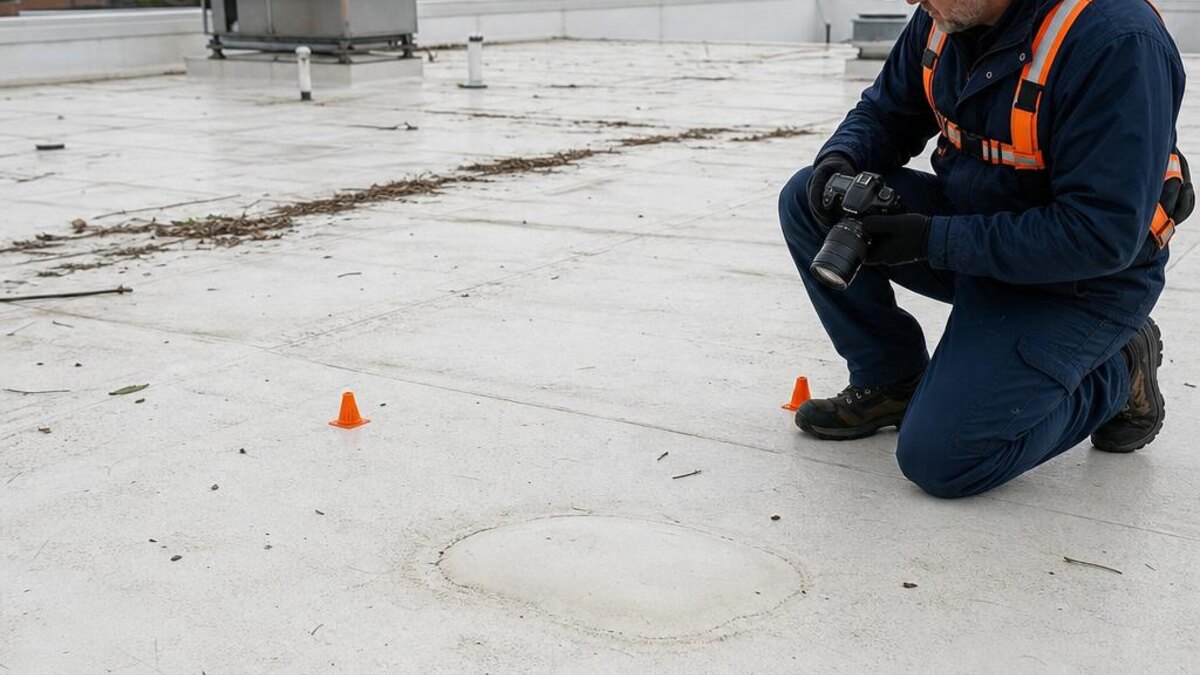
Start with safety and interior protection
A suspected roof problem can involve falling ceiling materials, wet electrical components, slippery surfaces, unstable roof areas, and severe-weather hazards. Keep occupants and staff away from affected areas, follow the building’s emergency procedures, and contact emergency services or the appropriate utility when there is an immediate life-safety or electrical concern.
From inside the building, move or protect equipment, inventory, and furnishings only when doing so is safe. Use established facility procedures for water collection and cleanup, and post warnings around wet floors. Do not send untrained personnel onto a wet, icy, storm-damaged, or unfamiliar roof to search for the source.
Key takeaways
- Interior symptoms do not pinpoint the opening. Water can travel along decks, insulation, framing, pipes, and penetrations before it becomes visible.
- Different conditions require different investigation. A puncture, blister, coating crack, drainage problem, flashing failure, and storm impact are not interchangeable.
- Documentation starts before repair. Time-stamped photos, weather information, leak locations, and roof records help preserve the sequence of events.
- Unapproved work can complicate the claim or warranty. Review notice requirements and obtain direction before non-emergency alterations when circumstances allow.
- Visible damage may not show the full extent. Concealed moisture and substrate conditions can change the repair or restoration scope.
Build an incident record before conditions change
A useful record connects the interior symptom, exterior event, and roof history without pretending to diagnose the cause. Capture observations from safe locations and keep original files rather than relying only on screenshots or compressed messages.
- Record the timeline. Note when the problem was first observed, the weather at the time, when precipitation began or ended, and whether rooftop work had recently occurred.
- Map interior locations. Mark affected rooms, ceiling areas, equipment, and floor locations on a plan when one is available.
- Photograph changing conditions. Take wide views for context and closer views of stains, active water, displaced ceiling materials, and damaged contents from safe positions.
- Preserve roof records. Gather system drawings, installation and coating dates, inspection reports, warranty documents, repair invoices, and rooftop-equipment work orders.
- Track notifications. Keep the date, time, contact, and instructions associated with calls to the property team, roof professional, insurer, manufacturer, or warranty administrator.
Do not discard damaged materials, erase surveillance footage, or cover a suspected condition before asking whether an insurer, manufacturer, consultant, or other party needs to observe it. Emergency stabilization may still be necessary, but the reason, scope, and before-and-after condition should be documented.
Leak, puncture, blister, or storm damage: what the terms suggest
These labels describe observations, not complete diagnoses. The comparison below helps owners communicate what they see while leaving the cause and corrective scope to the assessment.
| Observed condition | What it may indicate | What the assessment needs to establish |
|---|---|---|
| Interior leak or stain | Water entered somewhere, but the route may involve roofing, flashings, walls, mechanical equipment, plumbing, condensation, or another source. | Entry point, travel path, affected materials, moisture extent, and whether more than one source exists. |
| Puncture or gouge | Foot traffic, dropped tools, sharp equipment, service work, debris, or impact may have interrupted the coating and foam. | Depth, area, moisture entry, condition of surrounding foam, and compatibility of the specified repair system. |
| Blister, bubble, or raised area | Loss of adhesion, trapped moisture or vapor, substrate movement, application conditions, or another assembly issue may be involved. | Which layer has separated, how far it extends, whether moisture is present, and whether the condition is isolated or systemic. |
| Storm or hail indication | Impact, windborne debris, displaced equipment, edge damage, abrasion, or water entry through disturbed details may have occurred. | Event-related damage versus prior wear, affected roof zones and details, coating continuity, foam condition, and deck or attachment concerns. |
Why an SPF roof leak may appear away from the entry point
SPF roofing is field-applied and can form a continuous insulated surface, but the roof still includes penetrations, edges, drains, curbs, transitions, coatings, and connections to other building components. Water can move through or along those interfaces before it appears indoors.
A ceiling stain directly below a roof area is useful evidence, not proof of the opening’s location. The investigation may need to compare interior mapping with roof details, drainage patterns, recent work, visible damage, and moisture evaluation. For the broader decision framework, review when a commercial roof should be restored, recovered, or replaced.
How to handle punctures and rooftop-trade damage
Mechanical, electrical, solar, communications, and maintenance work can introduce foot traffic, fasteners, dropped tools, temporary supports, sharp debris, and new penetrations. If damage is suspected after another trade worked on the roof, preserve the work order, contractor information, access times, equipment route, and before-and-after photographs.
Restrict further traffic around the affected area without placing markers, tape, fasteners, coverings, or equipment in a way that adds damage. A qualified roof assessment should determine the boundaries of the condition, whether water reached the foam or underlying assembly, and which compatible materials and preparation are required.
What a blister does—and does not—tell you
A raised area may occur at different interfaces within the roof system. Visual appearance alone does not establish whether the coating, foam, an underlying roof layer, or the substrate has lost adhesion. It also does not establish whether the area contains moisture.
The assessor may review soundness, boundaries, nearby details, weather exposure, roof history, and concealed conditions. Cutting, probing, injecting, or flattening a blister without an approved investigation plan can destroy evidence, expose materials, and expand the affected area.
After hail, high wind, or windborne debris
Wait until the severe-weather threat has passed and authorized personnel determine that access is safe. Storm review should extend beyond obvious marks in the roof field. Edges, flashings, penetrations, drains, rooftop units, screens, panels, piping, supports, and displaced debris can all affect the roof or create water-entry paths.
Document the event date and available weather reports, but do not label every visible condition as storm damage. A professional assessment may need to distinguish recent impact or displacement from earlier wear, installation conditions, maintenance issues, or unrelated leakage. The party determining insurance coverage may also have separate evidence and notice requirements.
Coordinate warranty and insurance communications
Warranty and insurance obligations vary. Review the actual documents rather than relying on a general rule. Some agreements specify who must be notified, how quickly notice must be given, who may inspect or perform work, and what records the owner must retain.
- Report the observed condition without overstating the cause.
- Ask whether an inspection is required before non-emergency work.
- Request written direction for temporary stabilization when possible.
- Keep estimates, photographs, reports, invoices, and removed-material records together.
- Separate emergency interior protection from permanent roof repair authorization.
A warranty is not the same as insurance, and neither automatically covers every leak or damaged condition. Coverage decisions belong to the issuing parties under their documents.
What a qualified roof assessment should clarify
The response should move from symptom to cause, extent, and scope. Depending on the event and roof, that can include review of access safety, roof history, visible coating and foam condition, edges and penetrations, drainage, moisture evidence, substrate condition, and the need for targeted openings or other testing.
The outcome may be a localized repair, removal and rebuilding of affected materials, broader restoration, recoating, or evaluation of another pathway. A small visible defect should not be used to assume that the damage is either trivial or widespread.
Move from triage to an accountable response
Once immediate hazards and interior exposure are controlled, assign one person to maintain the incident record and coordinate access, communications, and reports. That reduces conflicting instructions and preserves a reliable timeline.
For suspected roof damage within Score’s specialty, request a commercial flat roofing assessment. The assessment should define what can be observed, what remains uncertain, and whether the needed work fits SPF roofing and compatible coating services or requires other qualified professionals.