
Moisture investigation reduces uncertainty; it does not eliminate it
Concealed water can change whether a commercial roof should be repaired, restored, recovered, or removed. Yet the roof surface alone rarely shows the full extent. Moisture investigations help owners move from assumption to evidence by comparing broad-area survey indications with roof construction, leak history, and selected physical verification.
The findings belong within the larger decision to restore, recover, or replace a commercial roof. They should not be treated as a product recommendation by themselves.
What owners usually need the investigation to answer
- Are there indications of moisture beneath the visible roof surface?
- Where are suspect areas located, and how extensive do they appear?
- Do physical openings confirm the survey pattern?
- Which roof layers are present, and where is moisture or deterioration found?
- Is the condition localized enough for defined removal and rebuilding, or broadly distributed?
- What is the likely water-entry mechanism, and has it been corrected?
- How should findings affect restoration eligibility, repair quantities, contingencies, and project sequencing?
A useful report distinguishes observed facts, instrument indications, physical verification, interpretation, and recommendations. It should also document the roof and weather conditions under which the work was performed.
Common commercial roof moisture-investigation methods
The appropriate method depends on roof construction, surfacing, insulation, deck, weather, building use, access, and the question being asked. The descriptions below explain general roles, not a universal testing specification.
Infrared thermography
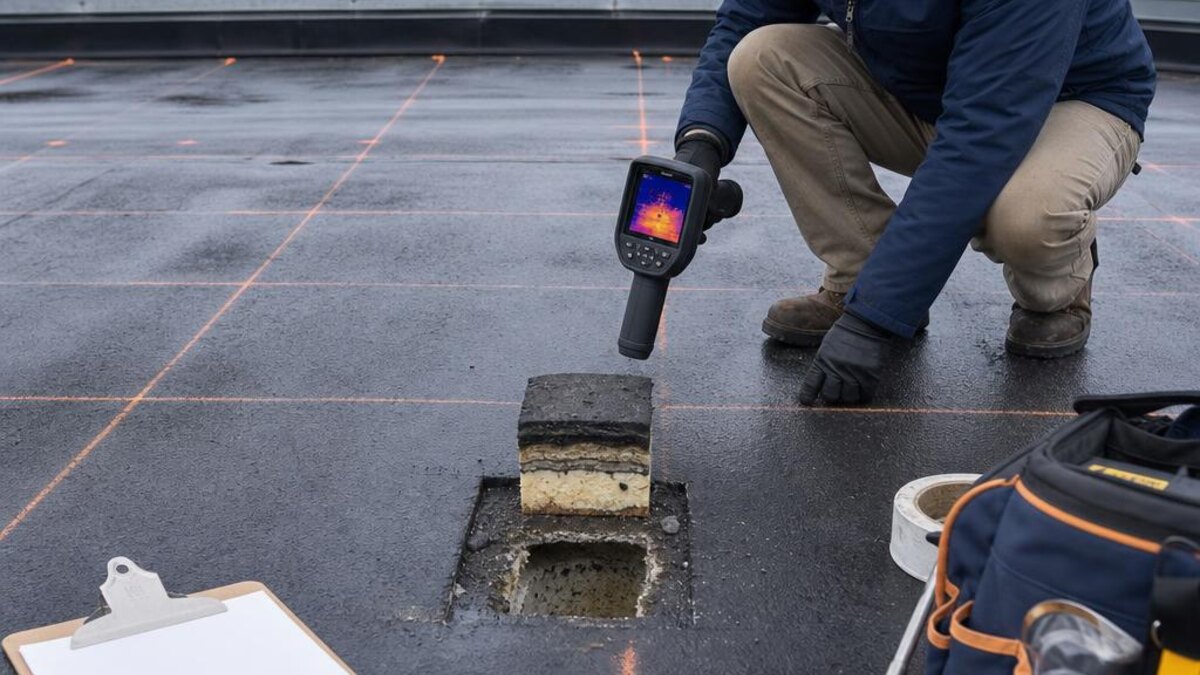
Infrared surveys measure surface-temperature patterns rather than seeing water directly. Under suitable conditions, areas containing moisture may heat and cool differently from surrounding dry areas. The evaluator looks for patterns consistent with the roof's construction and thermal behavior.
Results can be affected by solar loading, clouds, wind, recent rain, interior heat sources, roof color, ballast, shading, repairs, thickness changes, and other material variations. Timing and weather matter. Suspect patterns commonly require marking, interpretation, and verification rather than automatic classification as wet insulation.
Capacitance or impedance scanning
Electronic meters or scanners can compare electrical properties across the roof and identify readings that differ from a baseline. These methods may provide dense coverage and immediate field feedback on suitable assemblies.
Conductive components, metal, surface moisture, salts, material type, thickness, and contact conditions can influence results. A higher reading is an indication to interpret—not proof of the moisture layer, source, or severity.
Nuclear moisture surveying
Nuclear gauges infer moisture-related conditions from the interaction between emitted radiation and hydrogen-containing materials in the roof assembly. A grid of readings can help map relative differences across a roof.
Interpretation must account for materials that contain hydrogen even when dry, changes in assembly thickness or composition, calibration, grid spacing, and regulated handling requirements. This work requires qualified providers and should be tied to verification locations.
Core samples and test cuts
A core or test opening provides direct information at a chosen point. It can identify roof layers, insulation type and thickness, attachment, visible deterioration, and the presence or absence of moisture at that location. Openings can also help explain and calibrate survey indications.
The limitation is sampling. One dry opening does not prove the roof is dry, and one wet opening does not establish that every surrounding area is wet. Locations should be selected purposefully from suspect and comparison areas, documented, and permanently repaired with materials and details appropriate to the existing system.
How the methods complement one another
Broad-area methods and physical openings answer different parts of the question. This comparison helps owners understand why a proposal may include more than one method.
| Method | What it can contribute | Important limitation |
|---|---|---|
| Visual and document review | Leak history, repair zones, drainage, details, surface defects, and assembly records | Cannot establish concealed moisture extent by itself. |
| Infrared survey | Broad temperature-pattern mapping under suitable conditions | Detects thermal differences, not water directly; weather and construction affect patterns. |
| Electronic scanning | Relative electrical-property readings across a survey path or grid | Conductive and material variables can create non-moisture responses. |
| Nuclear survey | Relative hydrogen-related readings mapped across a grid | Dry materials and assembly changes can influence counts; regulated expertise is required. |
| Core sample or test cut | Direct observation of selected layers and conditions | Represents the location opened, not the entire roof. |
A strong investigation uses the roof's known construction and a clearly stated methodology to decide where verification is needed. It also records where the approach may be less reliable or inaccessible.
What a roof moisture report should document
- Purpose and scope. State the project question, roof areas included, methods, grid or survey path, and excluded areas.
- Existing roof information. Record known layers, deck, surfacing, repairs, leak history, drainage, and available drawings or warranty records.
- Conditions during the survey. Document relevant dates, time, weather, surface condition, recent precipitation, interior operating conditions, and access limits.
- Equipment and procedure. Identify the method, equipment, calibration or baseline approach, and any standard or manufacturer procedure followed.
- Mapped findings. Show suspect areas, reading locations, verification openings, roof features, and dimensions on a usable plan.
- Physical verification. Describe what each core or test cut found, including layers, thicknesses, visible moisture or deterioration, and completed repairs to the opening.
- Interpretation and limitations. Separate instrument response from confirmed condition and identify factors that could affect confidence.
- Project implications. Explain how findings affect repair quantities, removal zones, further investigation, contingencies, or restoration eligibility.
From a moisture map to a roofing decision
The percentage of suspect area is not the only factor. Location, connectivity, material type, deck condition, source, and the feasibility of removing and rebuilding affected zones all matter. Moisture around a recurring drain detail may support a different scope than scattered indications across unrelated roof areas.
A plan also needs to account for uncertainty between survey lines and openings. Repair boundaries may change when the roof is opened, so proposals should define how additional wet or deteriorated material will be measured, documented, priced, and approved.
Common interpretation mistakes
- Treating an infrared image as a photograph of water. It displays surface temperatures that require interpretation.
- Calling every elevated meter reading “wet.” Material and construction variables can influence readings.
- Using one core to certify an entire roof. A core verifies one selected point.
- Ignoring roof zones. Repairs, additions, shaded areas, different insulation, and multiple roof sections may behave differently.
- Mapping moisture without finding the cause. Replacing affected material without correcting entry paths can allow the condition to recur.
- Skipping permanent repair of openings. Test locations become roof details and need proper closure and documentation.
Use findings to define—not assume—the scope
A moisture investigation should produce better questions and more measurable proposals. Owners can ask which indications were physically verified, where methods were limited, how removal boundaries will be confirmed, and what happens if field conditions differ.
Score's commercial flat roofing assessment can connect roof history, visible conditions, moisture risk, drainage, details, and project goals before an SPF or compatible coating scope is considered. Independent roof consultants, laboratories, design professionals, or other qualified specialists may be appropriate when the building, assembly, warranty, dispute, or project complexity requires them.