
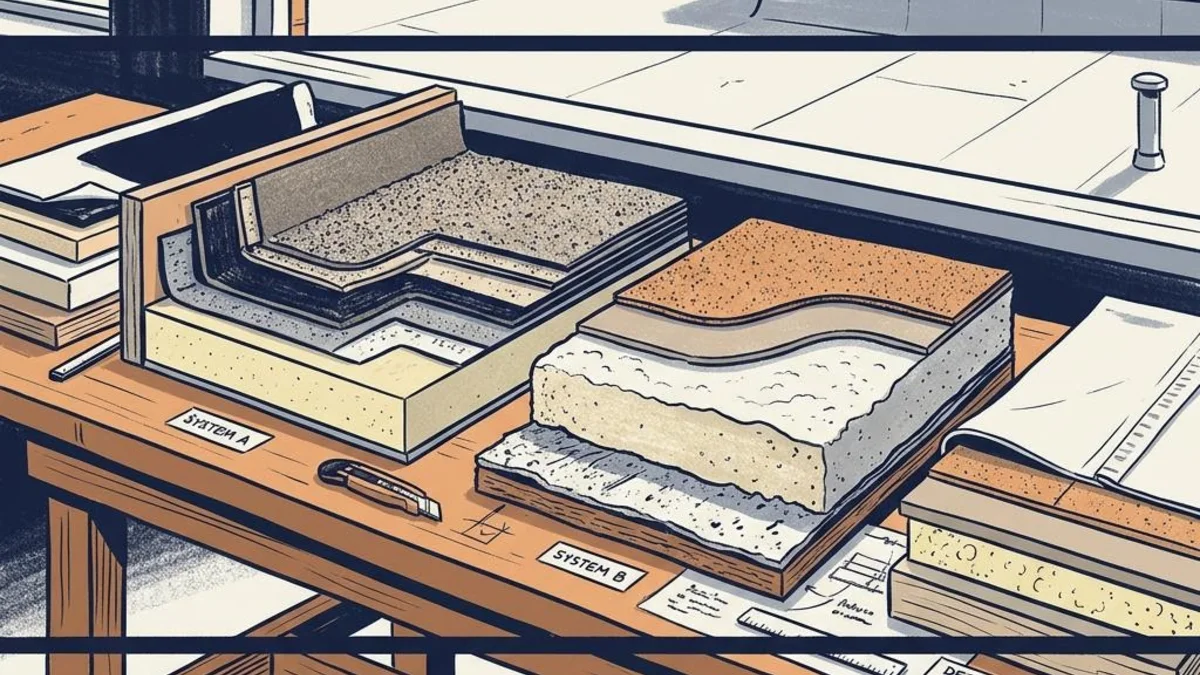
Recovery is not the same as coating
A roof recover adds a new roofing assembly over retained materials. An SPF recover includes roofing-grade foam and its compatible protective coating, along with preparation and detail integration. A coating-only restoration renews a suitable surface without automatically creating that new assembly.
Start with the broader restore, recover, or replace decision. This guide addresses the specific question of whether existing roof materials can remain under new SPF; it does not certify any membrane or building remotely.
Evaluate six conditions before retaining a roof
1. Identify the complete assembly
Records and appropriately selected openings help identify roof layers, insulation, attachment, deck, and previous repairs. A visible membrane name does not tell you what supports it or how many roofing layers are already present. Additions and repaired zones may have different assemblies.
2. Establish moisture condition
A dry surface does not establish dry insulation. Investigate recurring leaks and suspect areas using methods appropriate to the roof, with verification where needed. Retaining wet or deteriorated material can compromise the proposed system. The roof moisture survey and core-sample guide explains the limits of each method.
3. Check stability and attachment
The roof needs a reliable load path through the retained assembly. Bonding new foam to a loose surface does not secure the layers below it. Loose membranes, delamination, questionable fasteners, deteriorated deck areas, or structural concerns can require removal, attachment redesign, or professional evaluation.
4. Specify a compatible receiving surface
The proposed manufacturer should identify acceptable substrates, cleaning, primers, separation layers, cover boards, and adhesion checks. Existing surfacing, contaminants, coatings, and repair products can change the preparation. A successful sample-area adhesion result does not prove the concealed assembly is sound.
5. Reconcile drainage and details
Added assembly thickness changes relationships at drains, scuppers, curbs, edges, and wall flashings. Confirm that details can be rebuilt and overflow paths preserved. Foam should not be treated as a universal correction for structural deflection or inadequate drainage capacity.
6. Confirm project requirements
Applicable recover limitations, fire and wind requirements, loading, manufacturer approval, permits, and warranty conditions need project-specific review. The authority having jurisdiction and qualified design professionals determine the requirements; a material salesperson cannot waive them.
What the existing roof type changes
This table identifies questions for an evaluator, not permission to spray directly onto a listed material.
| Existing surface | Questions before specifying SPF | Do not assume |
|---|---|---|
| TPO or PVC | Is the membrane stable? Does the proposed assembly require separation or a secured cover board? | Direct foam adhesion is acceptable just because the sheet looks intact. |
| EPDM | How will membrane movement, attachment, contamination, and compatibility be addressed? | Covering a loose rubber membrane creates a secure assembly. |
| Built-up or modified-bitumen roofing | What surfacing, trapped moisture, loose material, and prior repairs must be addressed? | An aged asphalt roof is automatically a suitable receiving surface. |
| Metal | Are panels, fasteners, corrosion, movement, drainage, and underside conditions understood? | Foam restores lost metal capacity or solves every condensation issue. |
A cover board can provide a specified receiving surface, but it is not a way to conceal wet insulation or bypass inadequate attachment. Its material and fastening or adhesive system must belong to the proposed assembly.
When removal becomes part of the answer
Localized wet or deteriorated areas may be removed and rebuilt before recovery if the remaining roof is suitable. Widespread moisture, unstable layers, an unsound deck, incompatible construction, or unrebuildable details can make broader removal necessary.
Recovery should therefore be a conclusion supported by evidence, not a promise made before investigation. The benefits of retaining a roof are meaningful only when retaining it is technically and legally appropriate.
What a recover recommendation should contain
- A description of retained layers and the evidence supporting their condition.
- Mapped removal and repair areas, with a process for additional discoveries.
- The receiving-surface specification and attachment requirements.
- Drain, curb, perimeter, penetration, and transition details.
- Required approvals, inspections, exclusions, and maintenance obligations.
Learn how the new layers work together in spray foam roofing systems. For a New York or New Jersey property, a commercial flat roofing assessment can establish whether an SPF or compatible coating scope fits the conditions. Roofs needing other systems, structural work, or broader replacement require an appropriately qualified scope.