
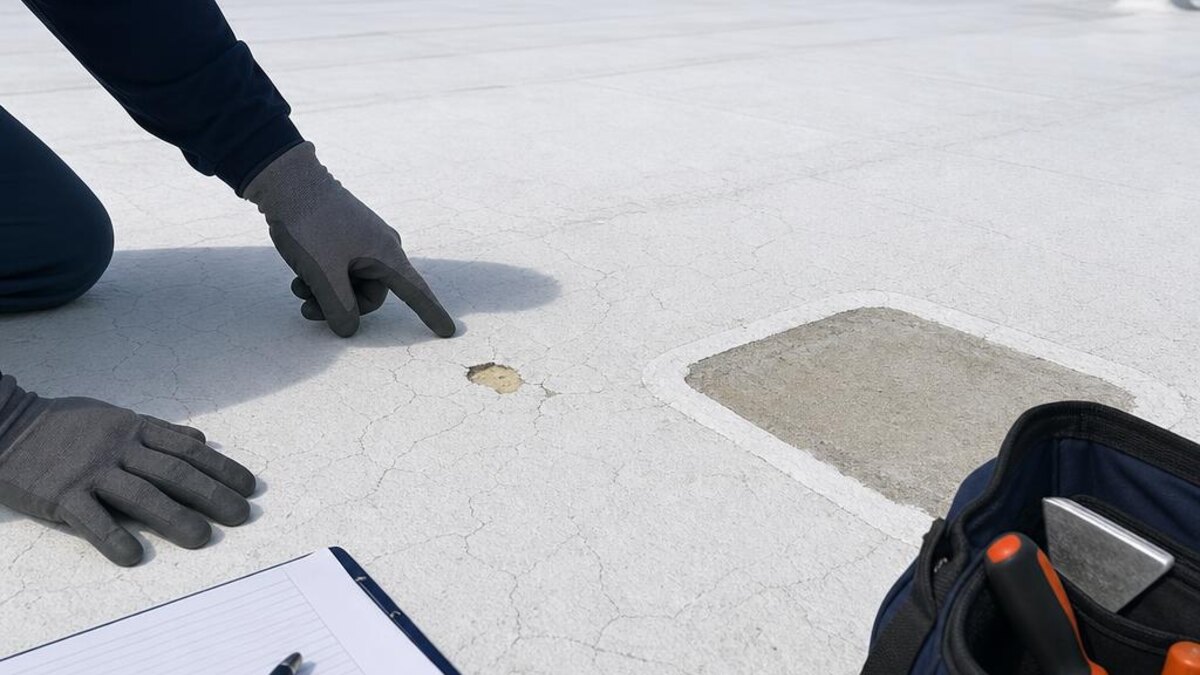
Repair and recoating solve different condition patterns
Localized repair addresses a defined defect or damaged area. Recoating renews the protective surface of a roof that remains an appropriate foundation for that work. Neither term should be used as a shortcut around moisture investigation, unstable materials, structural concerns, incompatible repairs, or details that cannot be integrated.
If the decision is broader than the condition of an existing SPF roof, start with Score’s restore, recover, or replace framework. It explains how deck condition, moisture, drainage, compatibility, code limits, and owner priorities affect the available pathways.
Key takeaways before choosing a scope
- Pattern matters. One puncture and widespread coating erosion are not the same problem.
- Cause matters. Repairing the surface without addressing traffic, equipment discharge, movement, drainage, or another cause invites recurrence.
- Moisture matters. A surface repair or new coating should not trap or conceal wet or deteriorated materials.
- Compatibility matters. Existing coatings, sealants, repairs, contaminants, and prepared surfaces must fit the proposed products and manufacturer requirements.
- Details matter. Drains, penetrations, curbs, walls, edges, flashings, transitions, and movement conditions can determine the scope.
- Age alone is not a scope. There is no responsible fixed year at which every SPF roof requires recoating or replacement.
A condition matrix for SPF roof decisions
The matrix helps owners decide what level of evaluation a visible condition may warrant. It is not a repair specification, warranty determination, or substitute for qualified field review.
| Observed condition | What it may indicate | Appropriate next question |
|---|---|---|
| Single puncture or cut | Localized impact or trade damage; depth and moisture consequences remain unknown | Is the affected area truly isolated, dry, and repairable with compatible materials? |
| Exposed or visibly damaged foam | Loss of protective coating or physical damage requiring prompt protection and evaluation | How far does the damage extend, and has moisture reached adjacent materials? |
| Distributed coating erosion or weathering | Protective surface may no longer be uniform across the roof zone | Is the foam suitable, and what preparation, repairs, testing, and coating scope are required? |
| Cracks or splits | Surface stress, movement, substrate change, detail failure, or incompatible repair | What is moving or separating, and can that cause be addressed before restoration? |
| Blisters or raised areas | Several possible conditions involving adhesion, vapor, moisture, substrate, or trapped materials | What type of blister is present, what lies below it, and is it isolated or widespread? |
| Recurring leak near a prior repair | Unresolved source, incomplete scope, water travel, or a failure outside the repaired spot | Does investigation need to extend beyond the visible repair and interior symptom? |
| Sealant or flashing change at a penetration | Movement, aging, equipment work, or detail discontinuity | Can the transition be rebuilt and tied into the roof system reliably? |
| New or expanding ponding | Blocked drainage, low areas, deflection, changed equipment, or altered water paths | Is the issue maintenance-related, roof-surface-related, or structural/drainage design related? |
| Widespread soft, unstable, or wet conditions | Potential system or substrate problem beyond a surface-renewal scope | What moisture, deck, removal, design, or replacement evaluation is required? |
Signs that may support a localized repair evaluation
A localized scope may be credible when the condition has clear boundaries, its cause is understood, affected materials can be identified, surrounding SPF and coating remain suitable, drainage and details are not part of a larger failure, and compatible repair materials can be integrated according to system requirements.
Examples can include a documented puncture from recent rooftop work, an isolated damaged detail, or a limited area affected by a known event. Even then, the visible opening may not show the full moisture path or subsurface condition. A qualified evaluator determines the repair boundary and whether testing or openings are needed.
Signs that may justify a broader recoating evaluation
Recoating evaluation becomes more relevant when the protective coating shows distributed wear or weathering rather than one isolated defect. The purpose is not simply to change the roof’s color. The evaluator needs to determine whether the existing foam, coating, details, drainage, repairs, and substrate can support a continuous compatible restoration system.
A recoating scope may need cleaning, preparation, removal of unsuitable material, localized foam repair, reinforcement, primer, adhesion checks, detail reconstruction, thickness or application-rate requirements, and quality-control documentation. Those requirements depend on the existing system and proposed products. Score’s commercial roof coatings and SPF recoating service explains the service context; project eligibility still comes from field conditions and system requirements.
Conditions that may require more than repair or recoating
Surface renewal is not a reliable answer to widespread wet materials, an unsound or corroded deck, extensive loss of adhesion, unstable substrates, recurring failures across unrelated areas, incompatible layers, significant movement, or drainage and structural conditions outside the roofing scope. These findings may lead to selective removal, redesign, recovery, replacement, or separate structural and drainage work.
Likewise, a leak does not prove that every part of the roof is failing. The source may be a penetration, wall, curb, drain, mechanical unit, plumbing condition, or another interface. Investigation should define both the entry path and affected materials before a broad scope is selected.
Why exposed foam deserves prompt evaluation
The coating protects SPF from ultraviolet exposure and weather. Visible exposed foam means that protective continuity has been lost at that location. The correct response depends on the extent, duration, surface condition, moisture, contamination, and compatibility—not simply applying any coating available.
Record the location and size without scraping, cutting, probing, or applying temporary materials that could obscure evidence. If exposure follows a puncture, storm, or rooftop work, also document the event, nearby debris, traffic route, and interior symptoms.
Cracks, blisters, and recurring leaks need diagnosis
Cracks and splits
A crack can reflect local coating stress, movement at a substrate or transition, an incompatible prior repair, or a deeper assembly condition. Its direction, depth, location, recurrence, and relationship to joints or equipment matter. Filling the visible line without understanding movement may not resolve the cause.
Blisters and raised areas
“Blister” is a visual description, not a complete diagnosis. Raised areas can involve adhesion, trapped moisture or vapor, substrate conditions, application history, or other mechanisms. Cutting or opening them without an authorized plan can create new water entry and affect evidence or warranty responsibilities.
Recurring leakage
Repeated symptoms may indicate that the original source was not found, water is traveling within the assembly, multiple entry points exist, or the condition involves an adjacent wall or piece of equipment. Compare current evidence with prior reports and consider whether qualified moisture investigation or test openings are needed.
No fixed lifespan determines the recoating date
Recoating timing varies with the original system, coating type and installed thickness, ultraviolet and weather exposure, drainage, rooftop traffic, contaminants, repairs, application quality, maintenance, and warranty requirements. A generic age claim cannot replace measured and documented condition.
Use a consistent SPF roof inspection and maintenance record to compare coating appearance, details, repairs, drainage, and traffic over time. Trend information is more useful than waiting for a calendar milestone or an active leak.
What to document before requesting an assessment
- Identify the location. Mark the roof zone, nearby equipment, drain, wall, curb, or penetration.
- Record timing and weather. Note when the condition appeared and whether it followed a storm, leak, or rooftop work.
- Take context and detail photos. Include an overview, a closer view, and a safe size reference without disturbing the surface.
- Gather history. Provide system records, warranty documents, prior repairs, inspections, coating information, and leak reports.
- Report operational constraints. Identify active equipment, occupied areas, sensitive operations, access limits, and urgent interior protection needs.
- Avoid obscuring the evidence. Do not apply an improvised patch or allow unrelated trades to alter the area before roofing review.
If the condition follows hail, windborne debris, a puncture, or an active leak, use the SPF roof damage triage guide to organize immediate documentation and professional review without attempting a DIY repair.