
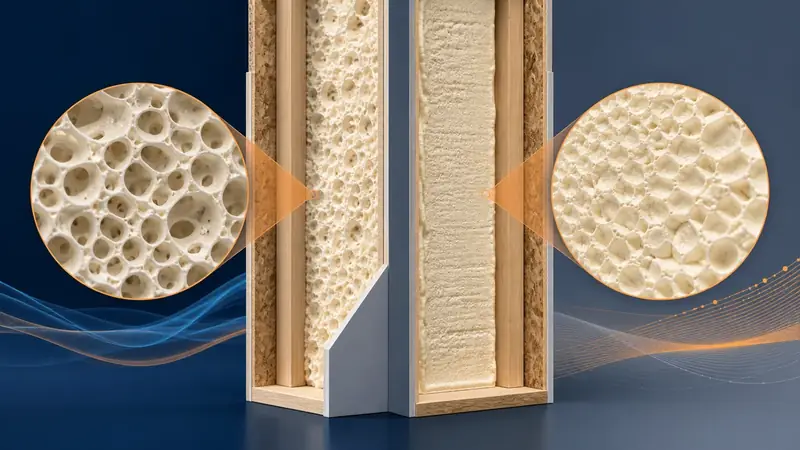
The short comparison
| Decision factor | Open-cell SPF | Closed-cell SPF |
|---|---|---|
| Density | Light, typically about 0.5 lb/ft³ | Dense, commonly about 2 lb/ft³ |
| Typical R-value | About R-3.6 per inch | About R-6 per inch; verify the product |
| Vapor behavior | Usually vapor-permeable | Can qualify as a vapor retarder at specified thickness |
| Liquid water | Can absorb and hold water | More resistant to water absorption |
| Texture | Softer and easier to compress | Rigid and harder to compress |
| Best fit | Assemblies designed to dry through the foam and with adequate cavity depth | Limited-depth, higher-R, exterior-exposure, or vapor-control applications when approved |
These are category-level tendencies, not a substitute for the selected product’s technical data, evaluation report, installation instructions, and the project’s code requirements.
Open-cell foam: useful when drying potential and cavity depth support it
Open-cell foam expands substantially and can create an effective air-control layer at a product-specific installed thickness. Because its R-value per inch is lower, reaching a target R-value generally requires more depth than closed-cell foam. It also remains more vapor-open, which can be useful in an assembly intentionally designed to dry through the foam.
That vapor openness is not permission to ignore moisture. The U.S. Department of Energy’s spray foam guide notes that open-cell foam can absorb and hold liquid water. Roof leaks, bulk water entry, and condensation risk must be addressed before installation.
Closed-cell foam: higher R-value and different moisture behavior
Closed-cell foam is roughly four times denser than typical open-cell foam and delivers more thermal resistance per inch. That makes it useful where cavity depth is limited or where the assembly calls for additional vapor or water resistance. It also remains rigid after curing.
The common phrase “closed-cell is waterproof” is too broad. Product data, thickness, seams, transitions, substrate, penetrations, and exposure conditions determine performance. Spray foam insulation is not a replacement for properly detailed roofing, flashing, drainage, or bulk-water control.
Five questions that decide the material
1. Where is the air boundary?
The air-control layer needs continuity across walls, roof or ceiling, rim areas, and foundation transitions. A cavity filled with foam can still perform poorly if adjacent transitions leak.
2. How should the assembly dry?
Some assemblies need inward drying, some outward drying, and some use dedicated vapor-control layers. Adding low-permeance foam to the wrong side of a moisture-sensitive assembly can reduce drying potential.
3. Is there enough depth for the target R-value?
Open-cell foam may fit deeper framing well. Closed-cell can reach a higher R-value in less space. The target is determined by code, design, and project goals, not by filling the cavity and assuming the result.
4. Could the foam encounter liquid water?
Active roof, foundation, plumbing, or drainage problems should be corrected before insulation. Foam must not be used to hide a leak or damaged substrate.
5. What protection and occupancy plan apply?
Spray polyurethane foam is manufactured on site from reactive chemicals. Installation requires trained crews, site isolation, ventilation, personal protective equipment, and product-specific occupancy and re-entry procedures. Finished assemblies may also require thermal or ignition barriers.
Common application examples
- Attics and roof decks: vented versus unvented design, roof condition, vapor control, HVAC, and fire protection matter before product choice.
- Exterior walls: cavity depth, sheathing, exterior insulation, cladding, and drying direction must work together.
- Crawl spaces and basements: bulk water, ground moisture, rim details, and protective coverings often drive the scope.
- Metal buildings: condensation risk, substrate temperature, adhesion, and fire requirements can favor a specific system.
How Score makes the recommendation
Score begins with the assembly and the problem to be solved. The proposal should identify the product, intended thickness, application area, preparation, required coverings, exclusions, and any conditions that must be corrected first. Explore the broader spray foam insulation service or request an assessment for a project-specific recommendation.