
The 2026 answer is different from the advice still circulating online
Many insulation articles still describe a federal tax credit worth up to $1,200 per year. That was accurate for eligible improvements placed in service through 2025. The IRS now states that the Energy Efficient Home Improvement Credit under Section 25C is not allowed after December 31, 2025. A proposal, deposit, or old webpage does not extend that deadline.
That does not mean every source of assistance has disappeared. New York and New Jersey continue to administer state, utility, income-qualified, and weatherization programs. The practical question is whether your household, property, utility territory, proposed measure, and contractor pathway meet the current rules.
New York: start with NYSERDA and your utility
NYSERDA’s EmPower+ program supports income-eligible households with energy assessments and eligible efficiency work. Published limits differ by income level and region. For downstate counties, including Kings, Nassau, Suffolk, and Westchester, the program currently describes higher project caps than many upstate areas. The final scope and contribution depend on the program’s assessment and approval process.
New York’s Home Energy Rebate pathway also identifies air sealing, insulation, and ventilation as eligible categories, subject to household income, program rules, approved measures, and available funding. A spray foam proposal is not automatically eligible simply because it adds insulation.
What New York homeowners should verify
- Whether the property is in the participating utility or program territory.
- Whether household income documentation is required.
- Whether an energy assessment must happen before contractor selection.
- Whether the exact assembly and insulation measure are approved.
- Whether the contractor must participate in a specific program network.
- Whether work begun before approval becomes ineligible.
New Jersey: check NJBPU, New Jersey’s Clean Energy Program, and Comfort Partners
The New Jersey Board of Public Utilities directs residential customers to statewide energy-efficiency programs. Income-qualified households may be eligible for Comfort Partners, which can provide no-cost energy-saving measures after qualification and assessment. Other pathways may be available through New Jersey’s Clean Energy Program, utilities, or weatherization assistance.
Program branding is not approval. Before relying on a rebate, verify that the property type, income tier, proposed insulation measure, installer, assessment, and installation date all satisfy the current rules.
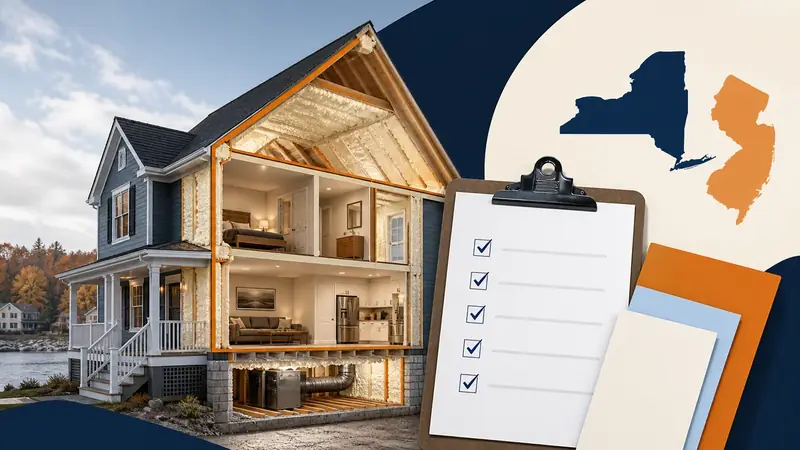
A six-step checklist before you count a rebate in the budget
- Identify the correct program. Start with the official state or utility site, not an ad or rebate aggregator.
- Confirm the application sequence. Some programs require an assessment and approval before a contract or installation.
- Define the building problem. Drafts, ice dams, condensation, comfort issues, and high energy use may point to different scopes.
- Verify the measure. “Insulation” is a category; the program may restrict materials, assemblies, R-values, testing, or documentation.
- Get the incentive in writing. Record the program, estimated amount, conditions, and who is responsible for filing.
- Keep the evidence. Save the assessment, product data, paid invoices, installation photos, approvals, and final test results.
What a responsible contractor should and should not promise
A contractor can help document the proposed area, material, thickness, and project cost. The contractor should also explain whether the work is an attic-floor air-sealing project, an unvented roof-deck assembly, a crawl-space enclosure, or another scope. Those distinctions can affect both building performance and program eligibility.
A contractor should not guarantee a tax result, represent an estimated incentive as cash already approved, or begin work that could disqualify the application. Homeowners remain responsible for confirming tax treatment with a qualified tax professional and program eligibility with the administering agency.
Plan the building first, then apply the incentive
The best project is not always the one with the largest headline rebate. Moisture, ventilation, roof condition, combustion safety, access, and the location of the air and thermal boundaries still determine whether a proposed insulation scope is appropriate.
For a home-specific assessment, review Score’s residential spray foam insulation service. The assessment can define a suitable scope; the official program administrator determines eligibility and funding.