
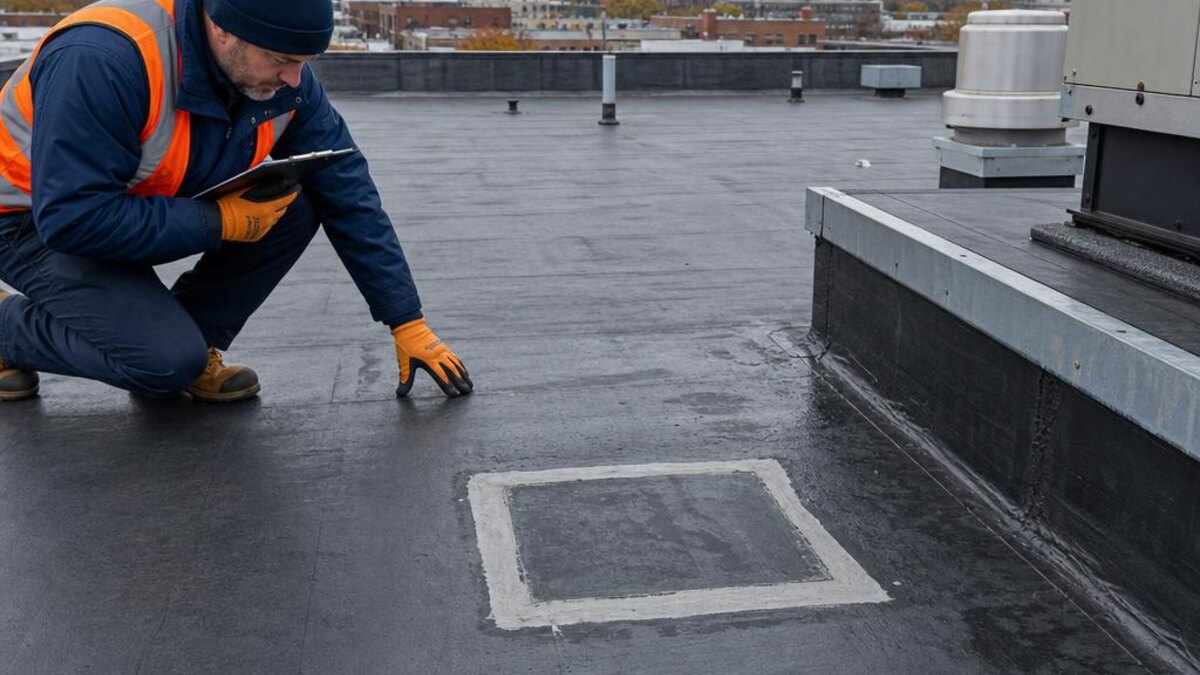
Coating eligibility is a roof-condition decision
Roof coatings can renew the protective surface of a suitable commercial roof, but they do not make every existing assembly suitable for restoration. Before choosing a coating product, the owner needs to know whether the roof can provide a stable, sufficiently dry, and compatible foundation for the work.
This eligibility question sits inside the larger choice to restore, recover, or replace a commercial roof. Coating is one possible restoration path—not a substitute for investigating why a roof leaks or what is happening below its surface.
Six conditions that support a coating scope
1. The roof and deck are sufficiently stable
The existing membrane, insulation, attachment, and deck need to support the proposed restoration work. Loose materials, broad delamination, corroded or deteriorated deck areas, recurring movement, or extensive loss of attachment can require removal, structural review, or another roofing pathway.
A coating adds a protective surface. It does not restore lost deck capacity or reconnect an unstable roof assembly.
2. Moisture is limited, understood, and addressable
Wet insulation and deteriorated materials should not simply be covered. Investigation may include visual review, roof history, infrared or electronic methods, and physical openings or core samples selected for the roof type and conditions.
The important question is not merely whether moisture exists. Its location, extent, source, and removability determine whether localized replacement can form part of a restoration scope or whether broader removal deserves stronger consideration. Score's guide to roof moisture surveys and core samples explains what different methods can—and cannot—show.
3. The surface is compatible and can be prepared
The proposed coating system must be compatible with the existing roof after required cleaning, repairs, drying, priming, and other preparation. Existing coatings, oils, dirt, biological growth, chalking, surfacing, corrosion, release agents, and previous repairs can interfere with adhesion.
Product identification, manufacturer guidance, adhesion testing, and representative test areas may all be relevant. One successful pull test or small sample does not prove uniform conditions across every roof zone, especially where age, exposure, repairs, or ponding vary.
4. Seams, flashings, and penetrations can be rebuilt
Edges, parapets, curbs, drains, scuppers, penetrations, expansion joints, equipment supports, and transitions frequently control performance. A proposal should define how failed or vulnerable details will be repaired and integrated, not merely state that the field of the roof will receive coating.
Where details cannot be reliably accessed or reconstructed, covering the field area alone may preserve the source of future water entry.
5. Drainage conditions are acceptable or correctable
Blocked drainage, isolated low spots, deflection, and chronic ponding need to be evaluated against the existing assembly and the proposed system's requirements. A liquid-applied coating follows the profile beneath it; it does not create slope by itself.
Drainage work may involve maintenance, detail repairs, localized rebuilding, designed slope changes, or broader structural and plumbing evaluation. The appropriate response depends on the cause, not only on the presence of standing water.
6. The complete scope can meet project requirements
Eligibility also depends on code, fire and wind requirements, recover limits, manufacturer instructions, warranty conditions, site protection, weather, occupied-building constraints, and the owner's maintenance responsibilities. The authority having jurisdiction, qualified design professionals, and system manufacturer determine project-specific requirements.
Conditions that should pause a coating recommendation
The following findings do not all produce the same decision, but each calls for additional investigation or a broader scope before coating proceeds:
- Widespread or poorly defined wet insulation or trapped moisture.
- An unsound, corroded, or otherwise questionable deck.
- Large areas of loose, blistered, deteriorated, or delaminated roofing.
- Unknown roof layers or existing materials that prevent a reliable compatibility determination.
- Recurring leaks across unrelated areas without an established cause.
- Active movement, open joints, failed transitions, or details that cannot be integrated.
- Chronic drainage problems that conflict with the proposed system or warranty conditions.
- Contamination or surface conditions that cannot be prepared to the system requirements.
A coating-candidate checklist for owners
Before comparing coating prices, ask each evaluator to document the basis for eligibility.
| Decision area | What should be documented | Why it matters |
|---|---|---|
| Existing assembly | Known roof type, layers, repairs, attachment, deck, and coating history | Compatibility and recoverability depend on what is already present. |
| Moisture | Methods used, roof conditions during testing, findings, verification openings, and affected areas | Concealed moisture can change preparation, repair quantities, or the entire pathway. |
| Surface condition | Cleaning, removal, repairs, primer, adhesion checks, and acceptance criteria | “Prepare as needed” is not a measurable scope. |
| Details | Treatment of seams, penetrations, curbs, walls, drains, edges, and transitions | A field coating does not automatically repair vulnerable interfaces. |
| Drainage | Ponding locations, drain and overflow condition, low areas, and proposed corrections | The cause and extent of retained water affect system selection and detailing. |
| System requirements | Named products, reinforcement, application rates or thickness, weather limits, warranty terms, and maintenance | A complete specification allows proposals and final work to be evaluated consistently. |
How adhesion testing fits—and where it stops
Adhesion testing can help evaluate whether a proposed primer or coating bonds to a prepared sample area. It is useful evidence, but it is not a full roof assessment. Results can vary with substrate, preparation, temperature, contamination, existing repairs, moisture, and exposure.
The test location and preparation should represent the roof zones being evaluated, and the acceptance method should follow the proposed system's guidance. A good result does not cure wet insulation, confirm deck condition, or establish that every detail can be integrated.
Move from eligibility to a defined restoration scope
If the roof appears eligible, the next step is not a generic instruction to “coat the roof.” The proposal should define investigation, removal of unsuitable materials, repairs, surface preparation, detail treatments, products, reinforcement, target application, protection, inspections, documentation, exclusions, and owner responsibilities.
Score's commercial roof coatings and SPF recoating service focuses on compatible protective systems for suitable roofs. An assessment should establish whether that specialty fits the conditions; roofs requiring another system, structural work, or broader replacement need an appropriately qualified scope.