
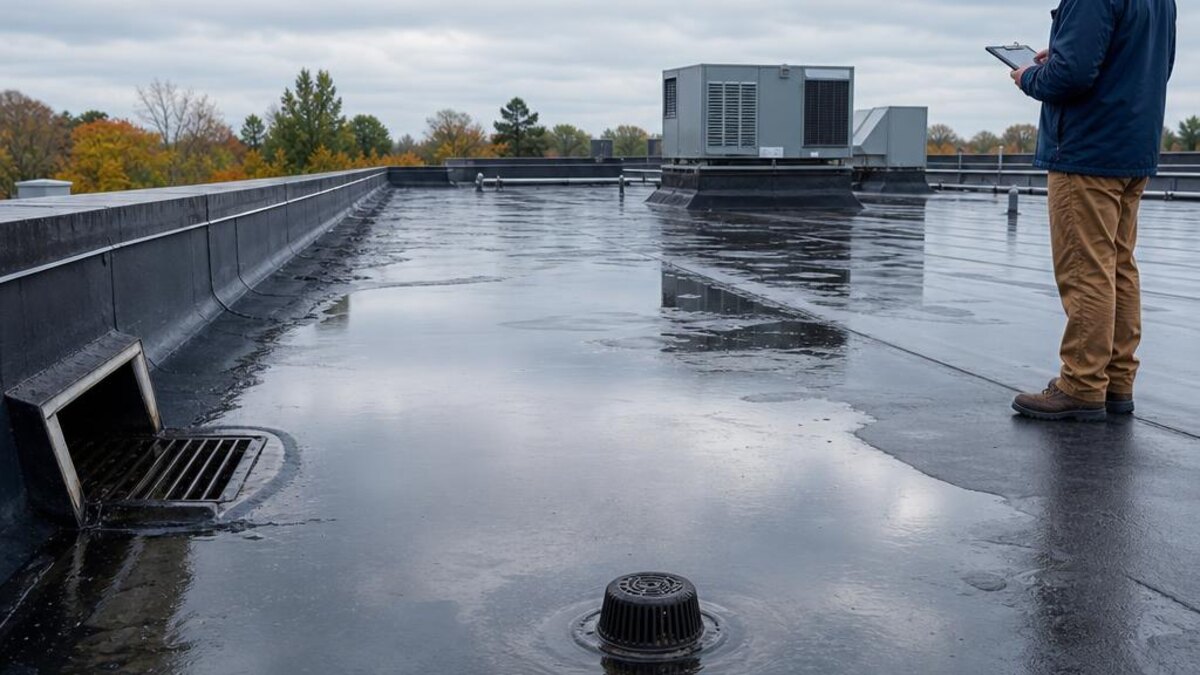
Ponding changes the questions a restoration team must answer
After rain, a low-slope roof should move water toward its primary drains, scuppers, or gutters and preserve its intended overflow path. When water remains in broad areas or repeatable low spots, an owner needs more than a proposal to “coat the roof.” The assessment should connect the water pattern to drainage capacity, roof geometry, structural conditions, existing materials, moisture evidence, and the proposed system’s requirements.
This does not mean every puddle requires a tear-off. It means the roof should be evaluated within the larger restore, recover, or replace decision before a product is selected.
Key takeaways
- Ponding is a condition, not a complete diagnosis. Duration, depth, area, recurrence, and cause all matter.
- A coating does not create slope. It follows the shape and movement of the prepared roof beneath it.
- Drainage components work as a system. Primary outlets, overflow provisions, crickets, saddles, roof slope, and maintenance access must be considered together.
- Hidden moisture can change the scope. Repeated ponding near an opening or failed detail may warrant targeted moisture investigation.
- Structural questions belong to qualified professionals. A roofer can document visible low areas, but deck deflection, loading, and redesign may require an engineer or other design professional.
- Product and warranty language is project-specific. Confirm the selected manufacturer’s written requirements instead of relying on a universal statement about ponding.
What “ponding water” should mean during an assessment
In ordinary use, ponding means water that remains on a roof after precipitation rather than draining within the expected period for that assembly and weather. A fixed time threshold is often repeated as if it applies to every roof, product, storm, and warranty. It does not. Evaporation, temperature, shade, debris, rainfall intensity, roof geometry, and manufacturer terms can all affect the observation.
A useful field record is more specific. It notes when the rain ended, when the roof was observed, the approximate boundaries and depth of retained water, the nearby drains and details, weather conditions, and whether the same areas recur. Photographs taken from repeatable locations can show whether the pattern changes after cleaning, repairs, or rooftop work.
A six-part drainage assessment before restoration
1. Map where water remains
Mark the field of the roof, around rooftop equipment, behind curbs, at transitions, and near drains or scuppers. A narrow puddle at an irregular patch presents a different problem from a large basin across a structural bay. The map should also identify seams, penetrations, blisters, cracks, displaced materials, and previous repairs within or beside the wet area.
2. Inspect primary and overflow drainage
Review drain bowls, strainers, leaders where accessible, scuppers, gutters, downspouts, and overflow provisions. Debris, coatings, poorly fitted strainers, displaced components, or later rooftop work can restrict flow. Clearing an obstruction may improve one condition, but recurring ponding can also indicate inadequate geometry, capacity, or structural movement.
Overflow drainage is not simply a backup convenience. Its location and elevation are part of the building’s water-management strategy. Any proposal that changes roof elevation at drains, edges, or overflow openings should explain how those relationships will be preserved.
3. Review slope, low spots, and transitions
Water can collect where the deck, insulation, or prior roof work creates a low area. It may also become trapped upslope of a curb, patch, conduit support, or abrupt transition. Measurements and a roof plan can help distinguish an isolated surface irregularity from a broader drainage problem.
New crickets, saddles, tapered insulation, drain modifications, or localized SPF shaping may be options in an appropriately designed scope. Their suitability depends on the existing assembly, attachment, dimensions, details, loading, drainage design, and manufacturer requirements. None should be assumed from a visual observation alone.
4. Investigate concealed moisture where evidence warrants it
Ponding water on an intact surface does not prove the insulation is wet. Conversely, a dry-looking day does not prove the assembly below is dry. Staining, recurring leaks, open seams, damaged penetrations, surface deterioration, or anomalies in a qualified moisture survey may justify test cuts or other targeted investigation.
The goal is to determine whether affected materials are localized and removable within a defined restoration scope or whether moisture and deterioration are too extensive for a reliable overlay. Score’s guide to roof moisture surveys and core samples explains what the common investigation methods can and cannot establish.
5. Separate roofing symptoms from structural questions
Persistent depressions can result from roof materials, installation geometry, deck deflection, framing conditions, or combinations of those factors. Visible roof inspection cannot establish structural adequacy. Signs such as unusual movement, widespread sagging, corrosion, cracking, displaced deck components, or a history of overloading should be referred for appropriate structural review.
Standing water adds weight, and blocked drainage can allow water to accumulate beyond ordinary conditions. The project team should not make structural assurances based only on a coating proposal or a roof walk.
6. Check the proposed system’s written boundaries
Coatings, primers, reinforcement, SPF, membranes, and repair materials have substrate, preparation, application, drainage, and warranty requirements. The proposal should name the products and written installation standard being used. General statements such as “silicone handles ponding” do not resolve substrate condition, wet insulation, adhesion, details, or drainage design.
Why a roof coating does not fix slope
A liquid-applied coating forms a protective layer over a prepared, compatible surface. It generally conforms to the existing profile. It can protect a suitable roof and reinforce specified details, but it does not lift a low deck, resize a drain, rebuild a deteriorated substrate, or reliably create drainage simply because extra material is applied in a depression.
Trying to build substantial thickness with coating can also depart from the intended application rate and curing behavior. Any change in roof geometry should be defined as a designed part of the system—not improvised during coating application. Owners considering a protective surface should first determine whether the roof meets the condition and drainage requirements for commercial roof coatings and recoating.
When SPF may shape localized drainage—and its limits
Spray polyurethane foam is field-applied and can be installed at varying thicknesses. In some suitable assemblies, that property allows a designed SPF scope to improve localized transitions or guide water toward drainage. The foam still needs a sound, prepared substrate and a compatible protective coating, and the new shape must integrate with drains, curbs, edges, penetrations, and overflow paths.
SPF should not be presented as a universal correction for structural deflection, undersized drainage, widespread deck movement, saturated materials, or geometry that requires engineered redesign. Learn how insulation, foam, coating, and details work together in Score’s guide to spray foam roofing systems.
How ponding affects the restore, recover, or replace decision
| Observed condition | Questions to resolve | Possible planning direction |
|---|---|---|
| Debris or a serviceable obstruction at an outlet | Does drainage normalize after qualified cleaning and inspection? Is the outlet and leader functioning? | Maintenance or localized repair may precede a broader restoration decision. |
| Isolated low area with dry, stable materials | Can the geometry and details be modified within a compatible, designed scope? | Localized correction may be considered as part of restoration or recovery. |
| Repeated ponding around failed details | Has water entered the assembly? Can affected materials and details be fully identified and rebuilt? | Targeted removal and repair may be required before restoration. |
| Broad ponding with widespread moisture | Are the insulation, attachment, and deck suitable to remain? | Recovery or replacement may require stronger consideration. |
| Low areas associated with deck movement or distress | What structural evaluation and redesign are required? | Pause product selection until qualified structural and drainage review is complete. |
| Inadequate or altered drainage and overflow paths | What code, plumbing, roofing, and design requirements govern correction? | Coordinate a project-specific drainage design rather than relying on coating alone. |
The table describes investigation pathways, not a remote diagnosis. Several conditions can exist on the same roof, and the scope may differ by zone.
Questions to require in a restoration proposal
- How was ponding documented? Ask for observation timing, mapped locations, photos, approximate dimensions, and nearby drainage components.
- What caused it? The proposal should distinguish known causes from assumptions and identify unresolved design or structural questions.
- What concealed-condition investigation is included? Define moisture surveys, test cuts, openings, and responsibility for repairs.
- How will drains and overflows be detailed? Confirm elevations, terminations, reinforcement, and protection during work.
- Does the manufacturer permit the conditions? Request project-specific written requirements rather than a verbal generalization.
- What remains outside the roofing scope? Structural, plumbing, deck, hazardous-material, and interior work should be clear.
The next step is a condition-led roof assessment
Ponding should move the project toward better documentation, not toward a predetermined product. A useful assessment connects the drainage pattern to the roof’s materials, moisture condition, details, deck, and building operations. Score’s commercial flat roofing assessment can evaluate whether repair, an SPF roofing or coating scope, or referral for broader design and replacement work fits the conditions observed.