
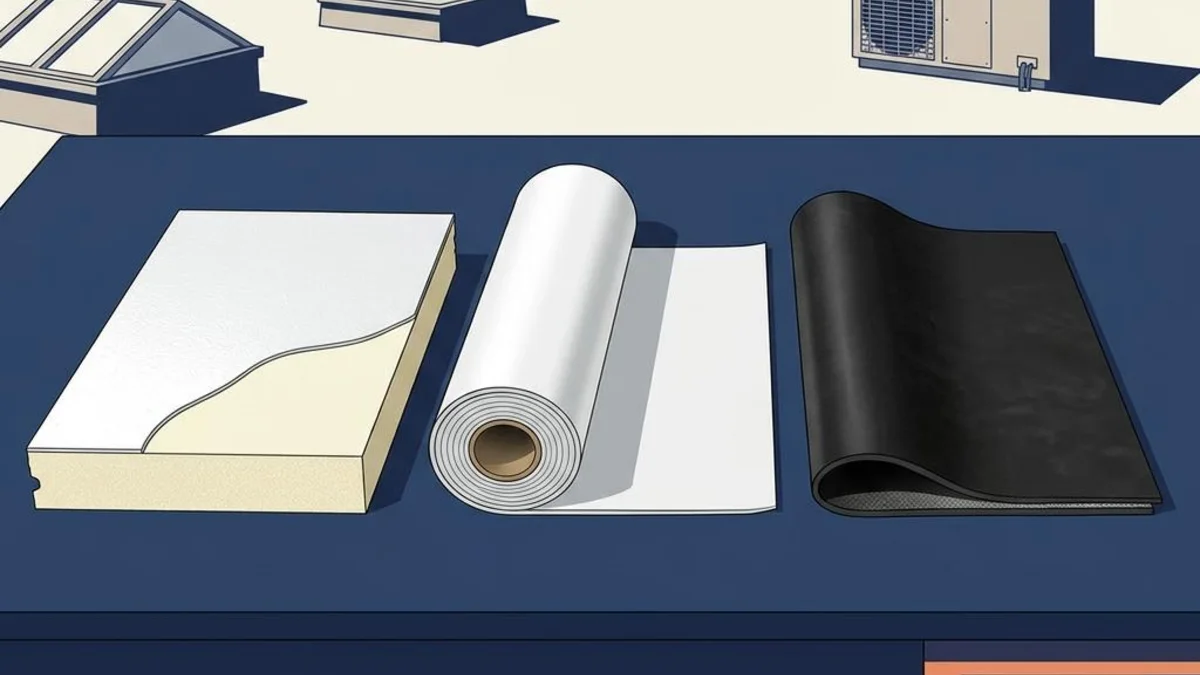
Compare assemblies, not just roof surfaces
An SPF proposal and a single-ply proposal may start from different assumptions. One may retain an existing assembly; another may include removal, new insulation, and a cover board. Their totals do not describe equivalent projects until the investigation, preparation, details, and exclusions are aligned.
First decide what the roof needs through the restore, recover, or replace framework. Then compare systems that can meet those needs. A material comparison cannot establish whether the existing deck or insulation is suitable to remain.
How SPF, TPO, and EPDM differ
The comparison below describes typical system characteristics. Product specifications and project-specific approved assemblies govern the actual work.
| Decision area | SPF roofing | TPO roofing | EPDM roofing |
|---|---|---|---|
| Weatherproofing approach | Field-applied foam with a compatible protective coating | Thermoplastic sheet with heat-welded seams and specified details | Synthetic-rubber sheet with specified seam tapes, adhesives, and details |
| Thermal performance | The foam layer provides insulation; performance depends on specified thickness and assembly | Insulation is provided by the underlying assembly, not the thin sheet alone | Insulation is provided by the underlying assembly, not the thin sheet alone |
| Attachment | Depends on adhesion to a suitable receiving surface and sound retained layers | May be mechanically attached or adhered, depending on the specified system | May be adhered, mechanically attached, or ballasted where the specified system permits |
| Details | Conforms to roof geometry; edges, drains, joints, and transitions still need designed details | Uses membrane flashings and accessories integrated with welded details | Uses compatible flashings and accessories integrated with specified seam methods |
| Installation constraints | Surface condition, temperature, moisture, wind, overspray, and coating cure matter | Surface condition, attachment, weather, and weld quality matter | Surface condition, attachment, weather, and seam preparation matter |
| Ongoing care | Inspect coating, foam damage, details, and condition-based renewal needs | Inspect seams, punctures, flashings, attachment, and drainage | Inspect seams, punctures, flashings, attachment, and drainage |
When SPF deserves closer consideration
SPF may be worth evaluating when an eligible roof can support a field-applied insulated assembly, irregular geometry needs coordinated detailing, and the site can accommodate spray application and protective coating work. Retaining suitable existing materials may be possible, but should not be assumed.
Review spray foam roofing systems for the layers and installation scope. A seamless field is not a guarantee against leaks: penetrations, movement joints, terminations, damage, drainage, and maintenance still affect performance.
Conditions that can count against SPF include an unsuitable receiving surface, unresolved moisture or attachment problems, and site constraints that prevent reliable spray control or acceptable application conditions. Those findings should change the recommendation rather than be explained away.
When a sheet-membrane scope may deserve consideration
A TPO or EPDM assembly may be among the options when the project calls for removal and rebuilding, the owner or design professional specifies a sheet system, or spray-application constraints limit SPF. Neither membrane name eliminates the need to evaluate insulation, attachment, deck condition, drainage, and flashing geometry.
Ask an appropriately qualified contractor or design professional to define the proposed sheet assembly. Score specializes in SPF and compatible coating work; this comparison is not an offer to install every roofing system.
Compare insulation and drainage on equal terms
Do not compare the thermal performance of a foam layer against a bare sheet membrane. Compare the whole proposed roof, including retained insulation, new insulation thickness, continuity, and thermal bridges. Likewise, a reflective roof surface is not a substitute for insulation or a building-specific energy analysis.
For drainage, compare the designed result rather than a material claim. SPF shaping or tapered insulation may form part of a project-specific slope strategy. Neither approach, by itself, resolves structural deflection, undersized outlets, or a blocked overflow route.
Ask the same five questions of every proposal
- Which existing materials stay, and what evidence supports retaining them?
- What insulation, attachment, perimeter, penetration, and drainage details are included?
- How will weather, site access, occupants, and adjacent property be managed?
- What inspections, documentation, warranty exclusions, and maintenance duties apply?
- How will unknown conditions and future rooftop alterations be handled?
For budgeting context, review commercial SPF roofing cost factors. For bid review, use the roof proposal comparison matrix. Neither a headline warranty length nor the lowest initial total establishes the best fit.
Choose the next investigation, not a winner in the abstract
If SPF is a candidate for your New York or New Jersey property, start with a commercial flat-roof assessment. The outcome may support an SPF scope, compatible coating work, or referral for another qualified system or design review. A useful comparison makes that boundary clearer.