
Start with a cause, not a coating of foam
For spray foam insulation for metal buildings, the first question is whether water is entering from outdoors, condensing on a cold surface, or coming from another source such as plumbing or a process. More than one mechanism can be present.
The EPA’s 2013 Moisture Control Guidance explains that humid air can deposit moisture when it contacts a surface at or below its dew point. That basic relationship helps organize an investigation, but a room-level humidity reading does not describe every hidden cavity or roof connection.
What observations help separate a leak from condensation?
| Observation | Possible explanation | What to investigate |
|---|---|---|
| Water appears during wind-driven rain near a penetration | Rain entry is one possibility | Roof details, seams, penetrations, and water paths |
| Droplets appear on cold mornings without rain | Surface condensation is plausible | Indoor dew point and surface temperature at the same time |
| Moisture increases during washing or other wet operations | Process moisture may be contributing | Source control, exhaust, schedules, and adjacent cold surfaces |
| Wetness remains near framing after broad surfaces improve | A cold bridge, local air path, or separate leak may remain | Connections, insulation continuity, and concealed conditions |
These are investigation prompts, not diagnoses. Rain can cool a roof enough to affect condensation, and water can travel away from its entry point before becoming visible. Do not classify every drip by its location alone or spray over corrosion before it has been assessed.
Two dew-point scenarios at the same indoor temperature
Assume a hypothetical building has indoor air at 70°F and an exposed metal surface at 50°F. Change only the relative humidity:
| Illustrative case | Indoor RH | Approximate dew point | 50°F surface comparison |
|---|---|---|---|
| Higher moisture | 60% | 55.5°F | Below dew point: surface condensation is possible |
| Lower moisture | 40% | 44.6°F | Above dew point under these assumed conditions |
That is why insulation and indoor moisture management cannot be treated as substitutes. Lowering the moisture content can change the condensation threshold; changing the assembly can change surface temperatures and air access. Neither example predicts the result of a Score installation or establishes a recommended humidity target for every building.
How to reproduce the numbers
The calculation follows the vapor-pressure/dew-point relationship described by the National Weather Service. Convert 70°F to 21.111°C. With RH expressed as a percentage, calculate g = ln(RH / 100) + [7.5 × ln(10) × T / (237.3 + T)], then Td = 237.3 × g / [7.5 × ln(10) − g]. Convert Td back to Fahrenheit. Here ln means natural logarithm.
These are rounded equilibrium estimates for the stated air conditions, not a condensation-rate calculation. They do not model transient weather, concealed layers, solar effects, thermal bridges, sensor error, or local moisture pockets. The surface temperature is an assumed input, not a prediction from an insulation thickness.
What spray foam can contribute
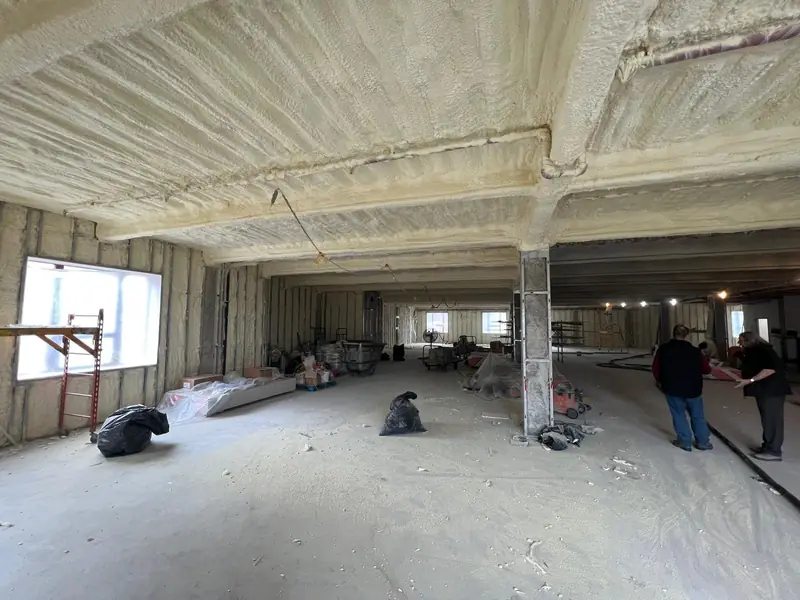
A suitable, continuous foam assembly can provide thermal resistance and air control at the treated surface. The designer must consider product-specific vapor behavior, thickness, adhesion, and connections around framing, fasteners, openings, and roof-to-wall junctions. Simply covering the broad metal panel while leaving critical transitions unresolved may not address the problem.
For work limited to the underside of a roof, see commercial roof-deck insulation. That is interior work, not a new weatherproof roof surface. Our separate exterior SPF roof vapor-control guide discusses a different assembly and should not be used as an interior application specification.
What foam does not replace
- Roof repairs: an interior insulation layer is not a remedy for failed exterior waterproofing.
- Corrosion assessment: determine substrate condition, compatibility, and preparation rather than concealing deterioration.
- Moisture-source control: washing, wet materials, occupants, or other processes may require operational changes or mechanical design.
- Ventilation design: more outdoor air is not always drier air. Have a qualified professional evaluate conditions rather than adding fans by guesswork.
- Fire protection: exposed interior foam still needs the appropriate approved protection or assembly. See our thermal and ignition barrier guide.
Collect evidence before requesting a solution
Download the metal-building moisture observation log. Record when and where droplets appear, rain or weather conditions, indoor temperature and RH, building activities, door positions, and any professionally obtained surface measurements. Leave unavailable readings blank; do not invent values.
Measurements should be taken safely with suitable instruments. Reflective metal can make infrared readings misleading; have the measurement method checked before using a number to make a design decision. Do not climb to the roof or enter hazardous areas to fill in this worksheet.
After an intervention, compare observations under reasonably similar weather and operating conditions. One dry afternoon does not demonstrate a winter condensation problem is solved. Keep records of both building operation and assembly changes so the next assessment has evidence rather than a guess.