
Start with the building’s energy question
A roof that needs restoration and a building with high utility bills may have a useful opportunity in common—but they are not automatically the same problem. Lighting, ventilation, domestic hot water, equipment, operating hours, and walls or windows can account for substantial energy use that a roof upgrade will not eliminate.
For a commercial owner, the decision is therefore two-part: is commercial spray foam roofing suitable for the roof, and what incremental energy benefit would the proposed assembly provide? Establish the roofing need first. A savings forecast cannot make a wet or unstable roof suitable for an overlay.
Separate insulation from the reflective coating
| Change | What it affects | What the estimate needs |
|---|---|---|
| Added insulation | Heat transfer through the roof when temperatures differ | Existing effective assembly resistance, proposed insulation, thermal bridges, and indoor/outdoor conditions |
| Reflective finish | Solar heat absorbed at the roof surface | Existing and proposed reflectance/emittance, aged product ratings, sunlight, shading, and weather |
| Other scope changes | Potentially air leakage or equipment performance | Separate evidence: do not credit roofing with improvements outside its actual scope |
The U.S. Department of Energy’s Guidelines for Selecting Cool Roofs explains that benefits depend on climate, insulation, use, energy prices, and equipment efficiency. It also identifies a possible heating penalty from a cooler roof during heating periods. This is established background guidance, not a current NY/NJ tariff or a project-specific model.
In New York and New Jersey, an annual comparison must include both heating and cooling seasons. A summer surface-temperature reduction is not an annual savings percentage. Nor should separately estimated insulation savings and reflective-roof savings simply be added: the two changes interact.
Two transparent scenarios: the same added insulation, different starting points
The following is an original arithmetic comparison, not a field study or annual energy simulation. Both scenarios use a hypothetical 10,000-square-foot roof, an assumed 30°F temperature difference, and an assumed added R-14. Starting equivalent roof R-values of 10 and 30 were chosen to illustrate sensitivity; they are not measured conditions or claims about typical NY/NJ buildings.
For a simplified, uniform roof with heat flowing in series, U = 1/R and steady-state heat flow Q = area × temperature difference × U. R uses h·ft²·°F/Btu; U uses Btu/(h·ft²·°F); Q is Btu per hour. This calculation excludes solar effects, thermal bridges, air leakage, moisture changes, and dynamic heat storage.
| Illustrative input or result | Lower starting insulation | Higher starting insulation |
|---|---|---|
| Starting equivalent R-value | R-10 | R-30 |
| Added insulation / resulting R-value | R-14 / R-24 | R-14 / R-44 |
| Heat flow before | 30,000 Btu/h | 10,000 Btu/h |
| Heat flow after | 12,500 Btu/h | 6,818 Btu/h |
| Reduction in roof heat flow | 17,500 Btu/h (58.3%) | 3,182 Btu/h (31.8%) |
The useful finding is the difference between starting conditions: the same added insulation produces a much larger absolute reduction in the lower-R scenario. The roof’s measured or professionally estimated starting condition matters more than a generic “saves up to” claim. For material and thickness selection, use the separate SPF thickness and R-value guide.
Download the editable evaluation worksheet
Download the SPF roof energy-evaluation worksheet (CSV). Open it in Excel, Google Sheets, or another spreadsheet application. The two example columns contain formulas; changing the area, starting R-value, added R-value, or temperature difference updates the comparison in applications that evaluate imported formulas. Use positive area and starting R-value, and nonnegative added R-value and temperature-difference magnitude.
The second part is an information-gathering worksheet for annual analysis: utility records, schedules, equipment, existing assembly evidence, and proposed product data. Blank entries mean “not yet established,” not zero. The file deliberately does not invent a dollar-savings result from missing inputs.
What an annual energy estimate should include
- A documented baseline. Gather at least a full year of utility use and costs, preferably multiple years where available. Record vacancies, occupancy changes, setpoints, and unusual shutdowns. Identify whether meters include other buildings or non-roof-related loads.
- A credible roof model. Identify retained layers, effective thermal resistance, wet insulation or thermal bridges, and the proposed assembly. A core sample may help establish construction; it does not by itself measure whole-building energy performance.
- Appropriate local weather and schedules. Use an identified weather dataset and realistic occupied hours. Do not multiply a peak-condition result by 8,760 hours and call it annual savings.
- Equipment and tariff assumptions. Heating efficiency, cooling efficiency, heat-pump performance, demand charges, fuel prices, and seasonal operation affect conversion from thermal loads to purchased energy and cost.
- One combined model, with sensitivity cases. Compare the same baseline with insulation-only, coating-only, and combined changes. Show how uncertain inputs change the answer rather than hiding them behind a single payback number.
An energy professional can select an appropriate modeling method and explain how its baseline relates to utility records. Keep energy savings separate from maintenance costs and avoided tear-off costs when reviewing the roofing investment. Avoided work is not recurring annual energy savings.
What the Staten Island project does—and does not—demonstrate
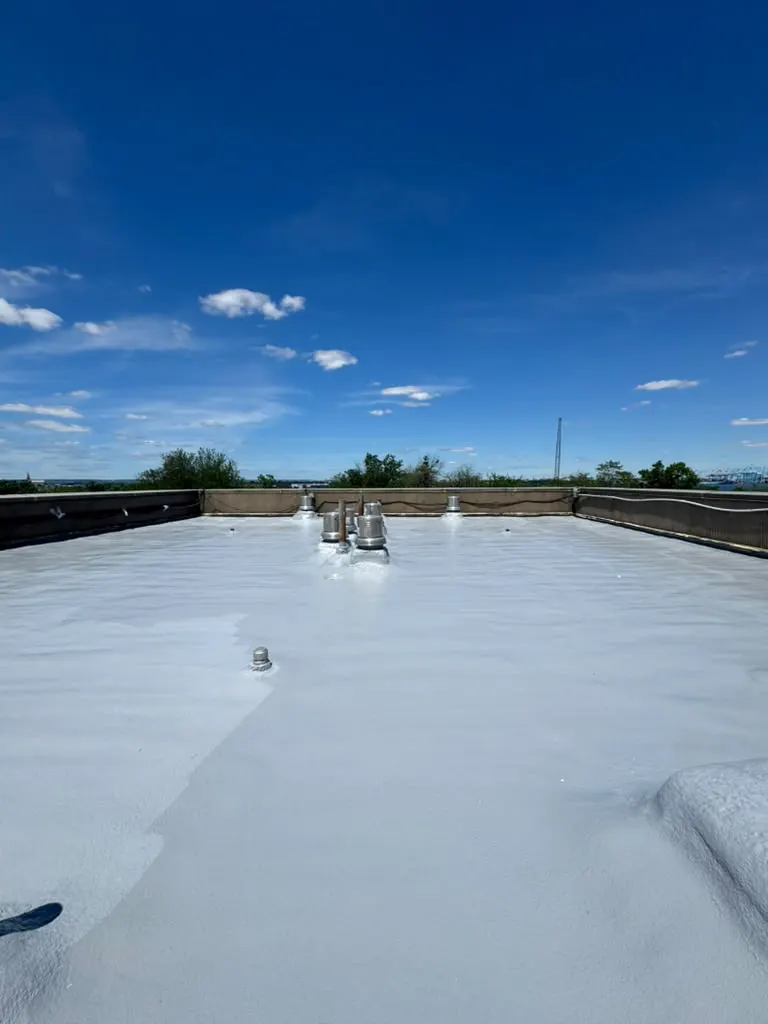
Score’s four-tower Staten Island restoration covered more than 80,000 square feet in total. Score reports more than two inches of SPF, an estimated added R-14 or greater, and a white silicone finish. That is evidence of installed scope, not a measured energy outcome.
No pre/post utility analysis or calibrated energy model has been supplied for that case study. The worksheet’s 10,000-square-foot examples are independent hypothetical scenarios; they must not be scaled up and represented as savings achieved on those towers.
After installation: test the prediction fairly
Keep the original assumptions, product data, installation scope, and utility baseline. Compare later energy use with attention to weather, occupancy, operating hours, and other upgrades. A lower bill could reflect lower energy prices rather than less energy use; a higher bill could accompany a larger occupied area. Agree on the evaluation method before promising or reporting a result.